For OEM glove size grading, first agree the base size, measurement points and methods. Then define targets point by point across the size range and review the relevant samples. A size label, wearer hand chart or single scaling percentage cannot replace the finished-glove specification.
Start with the fit reference and the base size
Identify the style, intended fit, size range and base size used for development. A brand fit brief describes the intended wearer and fit; a finished-glove specification describes the product to be made; a size label identifies a position in your range. Keep these records distinct. If starting from an existing glove, identify the physical reference and record its condition. Measurements taken from that sample are observations until the buyer and factory agree which become production targets.
Define each point of measurement
Give each point of measurement (POM) a stable code and a written method. Mark the start, end and measurement path on photographs of the actual sample. Agree whether the reading follows a straight line, an edge or a seam. The points below are candidates for a project discussion; the factory and buyer must select and define the ones appropriate to the chosen construction. A name such as “palm width” alone is not a complete measurement instruction.
Measurement brief / candidate points
- Palm width
Mark the exact cross-hand line, palm or back orientation, and side boundaries. State how the thumb is positioned.
Width is not circumference; name the dimension and its unit.
- Overall length
Name the fingertip and cuff edge that form the endpoints. Show the path and whether a folded cuff is opened.
Use the same finger and cuff state on every reviewed sample.
- Finger and thumb lengths
Identify each digit separately. Mark the chosen base landmark, tip and measuring side on the sample photo.
Document the thumb method separately and distinguish left from right.
- Cuff opening
State flat width or circumference, the measuring position, and relaxed or defined extended condition.
Record an extended reading separately; do not assume a conversion between methods.
- Cuff length
Identify the cuff edge and agreed join or construction landmark. For a continuous knit, mark the selected boundary.
Define folded or unfolded condition and the path being measured.
Select and annotate these points on the actual project sample. No universal measurement positions or dimensions are prescribed here.
Make the measurement conditions repeatable
Record the unit, tool, glove position, finishing stage and material condition. State whether each point is measured relaxed or under a specifically defined extension; where extension is required, agree how it is applied and recorded. Include any agreed conditioning or rest procedure. Check left and right gloves separately using the same method. Do not compare a finished sample with an unfinished component or change units without an agreed conversion and rounding rule. Confirm that both teams can reproduce the method on the same reference sample.
Review fit in the selected construction
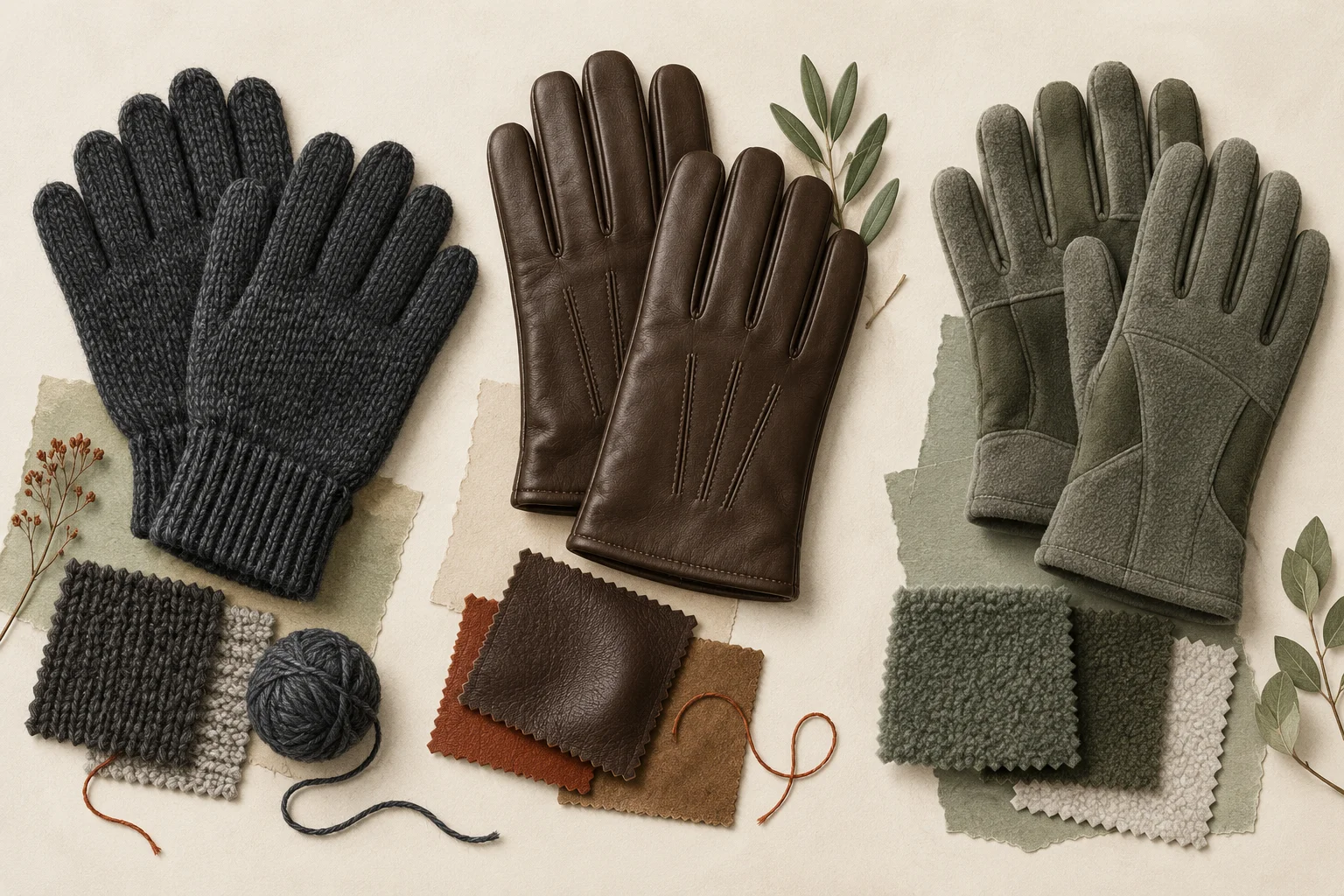
Keep the yarn or fabric reference, leather reference where relevant, pattern or knit construction, lining and cuff version with the size specification. Use the finished assembly for fit review. Flat measurements and a physical fit assessment answer different questions, so retain both records. When materials or construction change, review the affected measurements and fit before carrying over the previous approval. The checks below are discussion prompts for ordinary glove OEM development, not performance claims.
- Knit gloves
- Identify the yarn, knit structure, cuff and finishing state. Agree the relaxed measurement condition and record any extension check separately.
- Fleece gloves
- Retain the fabric and panel revision. Review finger reach, internal seam position and cuff entry on the assembled sample.
- Fashion leather gloves
- Identify the leather and lining references. Review the pattern, finger shape, seam position and fit of both gloves in the pair.
- Lined winter gloves
- Review shell, lining and any specified insulation together. Keep the complete assembly version with measurements and fit comments.
- Touchscreen gloves
- Review fingertip fit and the intended contact area on the selected base glove. Keep the agreed device checks tied to that sample and size.
Build the size range point by point
Agree the base-size targets first, then record a target for every selected measurement point in every ordered size. Describe whether a grade rule is measured from the base size or between adjacent sizes; mixing the two can produce the wrong chart. Discuss each point with the factory instead of applying one increment to every dimension. Record any point that stays unchanged explicitly. A calculated chart is a proposal until the agreed size-set samples and fit review support it. Keep size labels and order quantities separate from dimensional targets.
Four fields. Four different meanings.
- Target
- The required finished-glove dimension at a defined point and size.
- Grade rule
- The agreed change in a target across sizes, with its reference size stated.
- Tolerance
- The permitted deviation from the target. Record lower and upper limits or deviations explicitly.
- Actual
- The measurement observed on an identified sample, using the agreed method.
Tolerance controls variation around a target; it is not the size-to-size grading increment.
Review the size set against the same revision
Agree which sizes and samples will be reviewed, by whom and at which development stage. Record the sample identifier, size, left or right hand, POM code, specification revision, target, actual measurement and agreed lower and upper limits. Keep dimensional results separate from fit observations such as finger reach, seam position, lining movement and cuff entry. If no tolerance or method has been agreed, record an open decision rather than a pass. Consolidate comments into one revision list and identify what needs remeasurement or a new sample.
A blank field means an open decision, not zero or approval. Keep the source, responsible person and next action with each unresolved measurement or acceptance requirement.
Gather the evidence needed to complete the specification
The records below require information from the actual project. This guide and its blank worksheet supply no approved dimensions, grading increments, tolerances or sample results. Use the owner assignments as a starting point and confirm responsibilities with your supplier. For an undecided item, identify the missing source, responsible person and next review. Resolve the measurement and acceptance fields before releasing the affected specification for production.
Buyer input
Fit brief and size range
Intended fit, proposed size labels, base size, available brand fit data and an identified physical reference. State what is a target and what is only a reference.
Factory proposal / joint review
Measurement method
Actual sample photographs with POM codes, endpoints and paths; units, tools, glove position, material condition and any agreed extension or conditioning procedure.
Factory input / buyer confirmation
Materials and construction
Actual yarn, fabric or leather references; lining and cuff details; pattern or knit revision; finishing state and the sample identifiers reviewed.
Joint agreement
Graded targets and tolerances
A complete target for each selected point and ordered size, grade-rule basis, point-specific lower and upper allowances, and the approval of those values.
Joint review
Size-set evidence
The agreed sample coverage, actual left/right readings, fit comments, method photos, deviations, corrective actions and revised sample results where required.
Named approval contacts
Release and retained reference
Approved chart and sample versions, approver and date, resolved changes, release status and the location of retained physical references for repeat orders.
Release one specification and retain it for reorders
Keep the approved graded chart, measurement-method photographs, materials and construction revision, size-set review and physical reference linked by version. Record the approver, date and any remaining conditions, with a clear release decision. If the sample and written specification disagree, resolve the conflict before production. On a reorder, identify the retained reference and confirm any changes to materials, pattern, lining, finishing or labels. Update the affected documents and agree the review needed; a previous approval does not automatically cover a changed construction.
A reorder can look familiar while a changed component affects fit. Start by identifying the change and the measurements or fit decisions it touches. Agree the required review with the factory instead of automatically reusing the previous chart.
| Change requested | Review focus | Keep with the revised file |
|---|---|---|
| Add or change the lining | Inside finger space, entry and lining movement in the assembled glove. | New lining identifier and the agreed dimensional/fit review. |
| Change a straight cuff to a foldover cuff | Unfolded length, visible folded depth and measurement condition. | Separate point codes for the two positions and the label orientation. |
| Move a gathered wrist line | Its location relative to the palm and the finished opening. | Marked reference points and any separately defined extension method. |
| Change size-label wording only | Whether the change is only labeling or also changes the target size mapping. | The old-to-new label mapping; retain dimensional values only when confirmed unchanged. |
- 01
Resolve a conflict between sample and chart
Identify the exact point and revision that disagree. Have the buyer and factory decide which target is intended, update the affected reference and state whether remeasurement or a revised sample is needed. Do not silently choose whichever value is easier to manufacture.
- 02
Keep size quantities outside the grade rule
A size range explains dimensions; the assortment explains how many pairs to make. Send both records with matching size identifiers so a changed size name does not misallocate quantities in the order.
Buyer questions.
Can we use a universal glove size chart for an OEM order?
Use a chart agreed for the actual style, material, lining and fit brief. Size labels or a hand-measurement chart do not by themselves define finished-glove targets, measurement methods or tolerances.
Can development start from a reference glove without a graded chart?
Yes. Identify the physical reference and the intended fit first. Record its measurements as observations, then agree the base-size targets, size range, grade rules and review samples. Mark unresolved values as open; a measured reference is not automatically an approved production specification.
Who sets the grading increments and measurement tolerances?
The buyer and factory agree them for the selected construction and fit requirements. Record the grade rule and the permitted lower and upper deviations for each relevant point and size. This guide supplies no default increments or tolerances.
Should a lining or material change trigger another fit review?
Review the affected dimensions and fit when the material, lining, pattern or construction changes. Agree whether revised samples or size-set checks are needed, then retain the new approval with the updated specification.
Is a size-set approval also approval of the bulk order?
Keep development approval and order inspection distinct. VORLAN inspects every finished pair, including dimensions, against the agreed specification. Agree the acceptance criteria and release responsibility for the order; any additional buyer sampling inspection has a separate scope. A size-set review records the development samples actually assessed.
Can all glove measurements use the same grading increment?
Do not assume a single increment fits every point. Agree the target for each point and size with the selected construction in mind, then review the relevant size samples. No universal increments are supplied by this guide.
Can a previous size chart be reused after changing the cuff?
Identify the affected cuff measurements, opening and fit conditions first. Confirm which hand dimensions remain applicable and revise the changed points, methods and sample review as needed.
Size specification & review worksheet
Record measurement methods, graded targets, tolerances and sample results. All project values are left blank for your team and factory to agree.
Download the TXT template